Rather than merely torture visitors to this blog with my own insipid observations about great works of art, I'll also be pointing them to folks much better at writing about these things than I am. One of those is John Berger, in this piece on Caravaggio. Below is his comment on one of my favorite Caravaggios, The Calling of St. Matthew (which Berger would later rewrite a bit for his book Ways of Seeing.
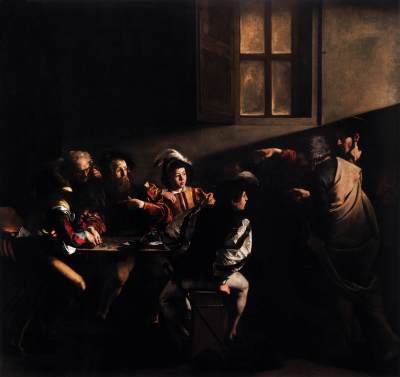
'The Calling of St. Matthew' depicts five men sitting round their usual table, telling stories, gossiping, boasting of what one day they will do, counting money. The room is dimly lit. Suddenly the door is flung open. The two figures who enter are still part of the violent noise and light of the invasion. (Berenson wrote that Christ comes in like a police inspector to make an arrest.)
Two of Matthew's colleagues refuse to look up, the other two younger ones stare at the strangers with a mixture of curiosity and condescension. Why is he proposing something so mad? Who's protecting him, the thin one who does all the talking? And Matthew, the tax-collector with a shifty conscience which has made him more unreasonable than most of his colleagues, points at himself and asks: is it really I who must go? Is it really I?
How many thousands of decisions to leave have resembled Christ's hand here! The hand is hold out towards the one who has to decide, yet it is ungraspable because so fluid. It orders the way, yet offers no direct support. Matthew will get up and follow the thin stranger from the room, down the narrow streets, out of the district. He will write his gospel, he will travel to Ethiopia and the South Caspian and Persia. Probably he will be murdered.
And behind the drama of this moment of decision is a window, giving onto the outside world. In painting, up to then, windows were treated either as sources of light, or as frames framing nature or an exemplary event outside. Not so this window. No light enters. The window is opaque. We see nothing. Mercifully we see nothing because what is outside is threatening. It is a window through which only the worst news can come; distance and solitude.


